 |
| Pigeon PA-02 |
The PA-02 was created in 1949 by order of the communist Chinese government to provide transportation for it’s citizens. (Flying Pigeon PA-02 Classic) Due to the success of the bike, it has gone on to become the bestselling vehicle of all time with 500 million units, or roughly three for every two US citizens. (Bicycling 66)To hold the human onto the frame the bike has a simple seat made from padded leather which is mounted on springs to give the rider increased comfort. To hold the seat in place, the bike features a simple welded tubular steel frame shaped like a pair of triangles joined at the edge. The use of tubular steel provides lightness in the design as well as simple repair-ability. Also, due to the tubularity of the frame, it is simple to bolt accessories onto the bike such as lights and bells.
 Holding the frame above the ground are two wheels, one at the front and one in the rear of the bike. Both are inline with each other and feature many thin metal spokes to create a strong wheel. The wheel is lined with a rubber tire which is filled with air to add further comfort for the rider, absorb some of the road vibrations to protect the bike, and assist in grip so the bike does not slip.
To transmit power from the rider to the wheels there are two pedals mounted to the frame which turn a chain in a clockwise manner.
 |
| Pedals |
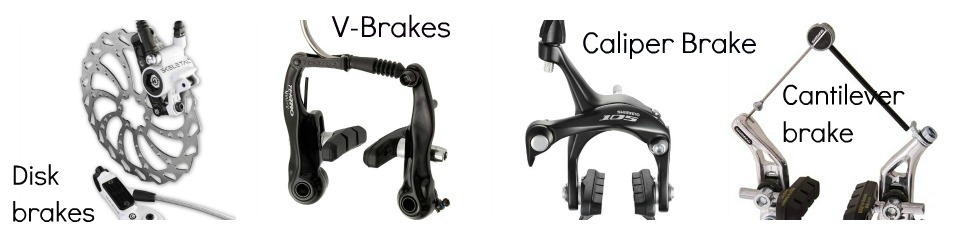
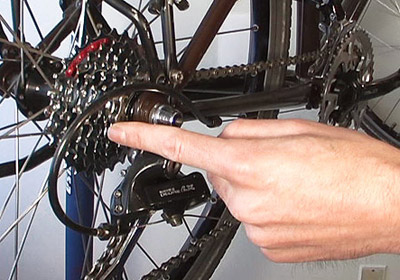 |
| Cog set |
A bicycle transmission is used to allow the rider to vary the proportion of speed to torque of the driven wheel from the pedals. While many bikes have only one of these options, called speeds, some bikes can have as many as 33 speeds.
 |
| Crank set |
The method by which they achieve so many different speeds is by having two different sets of gears, one called the
cog set, the other called the crank set. Each combination of a cog set gear with a crank set gear is a different speed. The total number of cog set gears multiplied by the total number of crank set gears yields the total number of speeds. A bicycle shifter mechanism is an extremely complicated system that is typically totally mechanically actuated.
cog set, the other called the crank set. Each combination of a cog set gear with a crank set gear is a different speed. The total number of cog set gears multiplied by the total number of crank set gears yields the total number of speeds. A bicycle shifter mechanism is an extremely complicated system that is typically totally mechanically actuated.
For each changeable gear set the rider has either a twist grip or a pair of mechanical actuators for selecting gears. When the rider actuates a change, a cable is tensioned and the bicycle’s chain is lifted off it’s current gear via a system called a derailleur and is then placed on the next highest or next lowest gear depending on which way the rider twisted the twist grip or which actuator they pushed.
(Rear Derailleur Basics) There is fundamentally very little variation on this variety of transmission but the most notable would be an electronic system which shifts gears for the rider.Bikes may have many different kinds of accessories. Some of the more popular ones include kickstands to hold the bike up when not in use, bells to perform the function of an automobile horn, reflectors to aid nighttime visibility, lights to aid night rideability, fenders to eliminate dirt flung at the rider, baskets to allow for greater holding capacity, clips to allow the upstroke to be a power stroke, bike computers to obtain data on a ride, water bottle holders, tow hitches, locks to deter theft, and even child seats. (Bicycle Accessories) The inexpensive and simple nature of the bicycle allows for many variants on the design of the bike and it’s components so any rider can find the perfect bike.
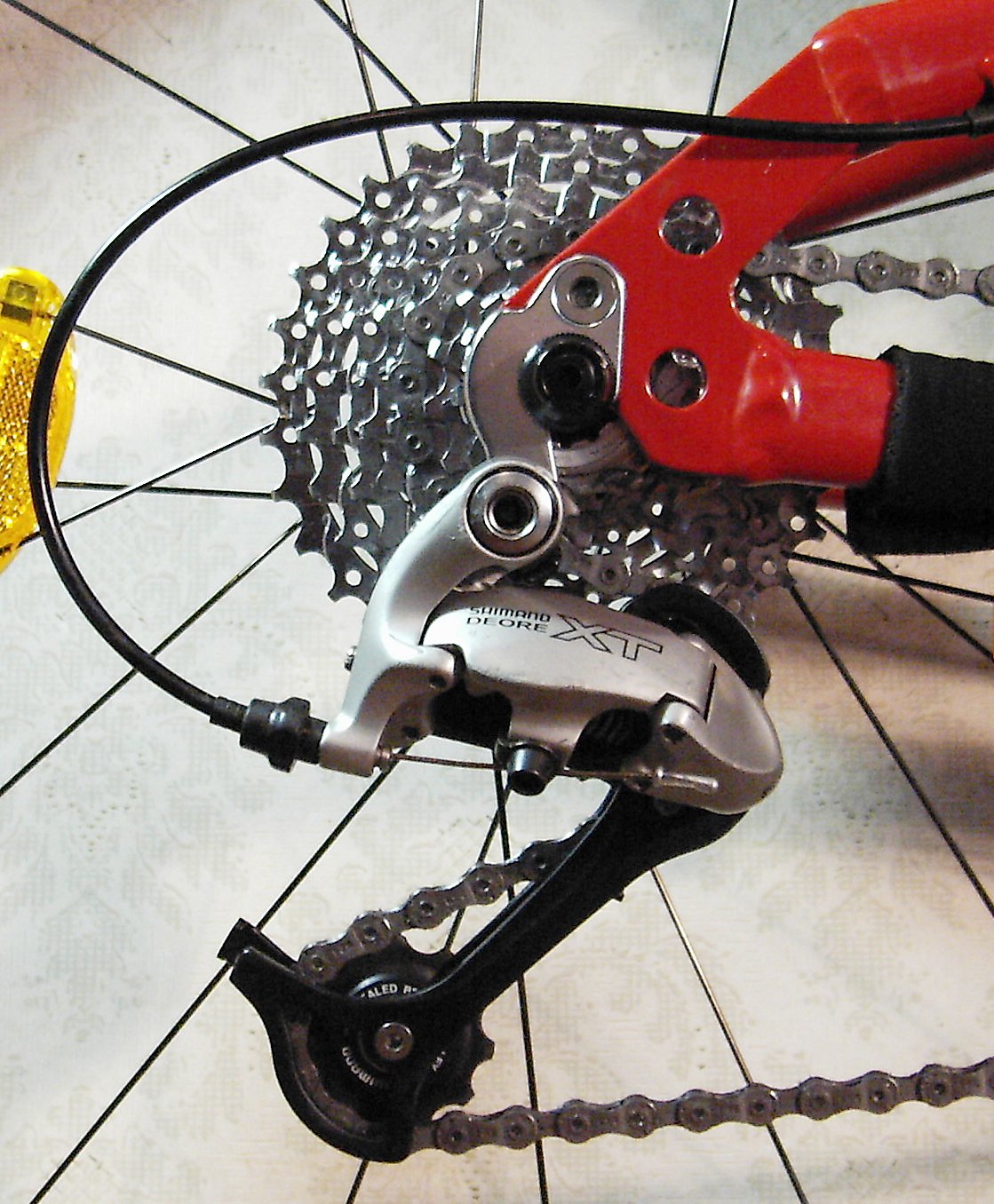 |
| Derailleur |
You can find an interactive chart of all bicycle evolution patterns here. (Be sure to click the image to activate it. Have Fun! :)
Works Cited
1."Bicycle Accessories." Bicycle Accessories and Why You Need Them. Web. 08 May 2015.
2. "Bicycling." Google Books. N.p., n.d. Web. 08 May 2015.
3. "Flying Pigeon PA-02 Classic." Flying Pigeon LA. Flying Pigeon LA, n.d. Web. 08 May 2015.
4. Rear Derailleur Basics. YouTube, 18 Nov. 2011. Web. 8 May 2015.

No comments:
Post a Comment